Weight meets volume

Grams to US liquid gallons converter

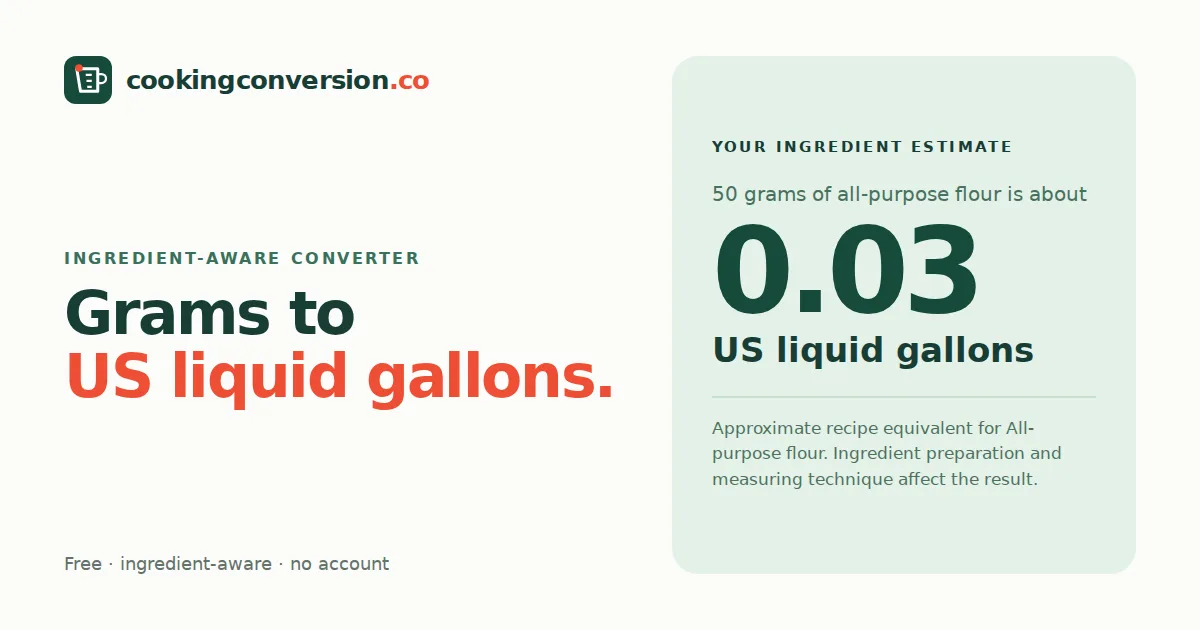
50 grams of all-purpose flour is about 0.03 US liquid gallons. Pick the ingredient and cup system your recipe uses; the reference behind every estimate stays in view.

Your kitchen converter

Spoon into the cup and level; do not pack

Decimals and fractions welcome: 0.5, ½ or 1 1/2.

Your ingredient estimate

50 grams of all-purpose flour is about

0.03

US liquid gallons


Approximate recipe equivalent for All-purpose flour. Ingredient preparation and measuring technique affect the result.

Reference: 120 g per 236.5882 ml US reference cup. More precision: 0.026 US liquid gallons.

Volume depends on the ingredient and the measuring method. Results crossing weight and volume are recipe estimates.

Grams to US liquid gallons table

Fixed reference: All-purpose flour · Spoon into the cup and level; do not pack. The calculator above is editable.

Grams to US liquid gallons for all-purpose flour at 120 g per US reference cup (approximate)
GramsUS liquid gallons (approx.)
1 g0.0005
5 g0.0026
10 g0.0052
25 g0.013
50 g0.026
100 g0.0521
200 g0.1042
250 g0.1302
500 g0.2604

US liquid measures at a glance

One gallon is 4 quarts, 8 pints or 16 cups. Every value is exact in US customary measures.

US liquid measures: gallons, quarts, pints, cups, fluid ounces, tablespoons and millilitres
MeasureQuartsPintsCupsFl ozTbspMillilitres
1 US liquid gallon48161282563,785.4118 ml
1 US liquid quart1243264946.3529 ml
1 US liquid pint0.5121632473.1765 ml
1 cup0.250.51816236.5882 ml
1 US fluid ounce0.03130.06250.1251229.5735 ml
Grams to US liquid gallons converter: 50 grams of all-purpose flour is about 0.03 US liquid gallons
Formula. US liquid gallons = grams ÷ grams per US liquid gallon of the ingredient. Example: 50 g of all-purpose flour → 0.026 US liquid gallons.

How to convert grams to US liquid gallons

This calculation crosses from mass to volume, so it needs an ingredient reference. The calculator starts with all-purpose flour at 120 grams per US reference cup (spoon into the cup and level; do not pack). Choose the exact ingredient and form your recipe means before using the answer.

For a weight input, convert to grams, divide by the ingredient's grams per reference cup, then adjust for the selected cup or spoon volume. For a volume input, reverse the process. The answer is a recipe equivalent, not a laboratory density measurement, so brand, moisture, packing and measuring technique can all change the practical result.

US and imperial gallons are not the same size

The US liquid gallon is 3,785.4118 ml, or 16 US cups. The imperial gallon used in the UK, Ireland and older Commonwealth recipes is about 20% larger (4,546 ml), and an imperial pint holds 20 fluid ounces where a US pint holds 16.

This site converts US liquid measures. If a recipe comes from a British cookbook and says pints, quarts or gallons, check its date and origin before assuming the US size; many modern UK recipes use millilitres and litres instead.

What are grams and US liquid gallons?

A gram is the metric unit of mass: one thousandth of a kilogram. Kitchen scales read in grams, which is why many recipes outside the US list dry ingredients by weight.

A US liquid gallon is defined as 231 cubic inches, exactly 3.785411784 litres, 4 quarts or 128 US fluid ounces.

Specific to this conversion

Grams to US liquid gallons: questions people ask

How many US liquid gallons are in one gram?

About 0.0005 US liquid gallons for all-purpose flour using our reference of 120 g per US cup. Another ingredient gives a different answer, because this conversion crosses weight and volume.

Is a UK gallon the same as a US one?

An imperial (UK) pint is 568.26 ml and holds 20 imperial fluid ounces; a US liquid pint is 473.18 ml and holds 16 US fluid ounces. Older British recipes can mean the larger pint. A US gallon is 3.785 litres; an imperial gallon is 4.546 litres. This page uses US liquid units.

What if my ingredient is not in the list?

Choose "Custom ingredient" and enter its weight for one US reference cup from a trusted chart or your own scale. The converter never substitutes a similar food; a missing reference stays missing rather than being guessed.

Sources behind the numbers

Sources checked September 25, 2026. Ingredient values are recipe equivalents, not laboratory densities.

Choose which optional categories cookingconversion.co may use. Strictly necessary storage is always on. You can change your choice at any time from the Cookie settings link in the footer.