Unit to unit

Grams to ounces (weight) converter

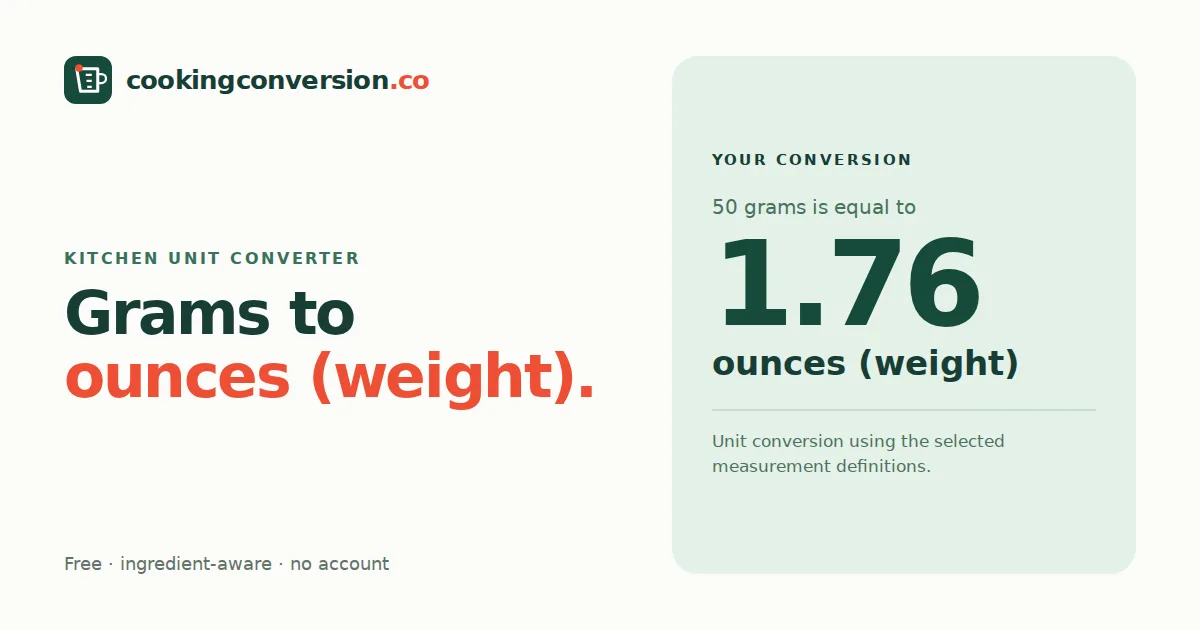
50 grams is equal to 1.76 ounces (weight). Both units measure mass, so the conversion is exact for the selected measurement system.

Your kitchen converter

Decimals and fractions welcome: 0.5, ½ or 1 1/2.

Your conversion

50 grams is equal to

1.76

ounces (weight)


Unit conversion using the selected measurement definitions.

More precision: 1.7637 ounces (weight).

Volume depends on the ingredient and the measuring method. Results crossing weight and volume are recipe estimates.

Grams to ounces (weight) table

US customary definitions. Values rounded to four decimals.

Grams to ounces (weight), US customary definitions
GramsOunces (weight)
1 g0.0353
5 g0.1764
10 g0.3527
25 g0.8818
50 g1.7637
100 g3.5274
200 g7.0548
250 g8.8185
500 g17.637

The grams amounts most often searched for this conversion. Every value comes from the same engine as the calculator.

Most searched grams to ounces (weight) amounts (exact, US customary)
GramsOunces (weight)As people search it
14 g0.4938 ounces (weight)14 grams to ounces
20 g0.7055 ounces (weight)20 grams to ounces
30 g1.0582 ounces (weight)30 grams to ounces
50 g1.7637 ounces (weight)50 grams to oz
60 g2.1164 ounces (weight)60 grams to ounces
100 g3.5274 ounces (weight)100 grams to oz
150 g5.2911 ounces (weight)150 grams to ounces
200 g7.0548 ounces (weight)200 g to oz
250 g8.8185 ounces (weight)250g to oz
500 g17.637 ounces (weight)500 grams to oz
Grams to ounces (weight) converter: 50 grams is equal to 1.76 ounces (weight)
Formula. ounces (weight) = grams × 0.0353. Example: 50 g → 1.7637 ounces (weight).

How to convert grams to ounces (weight)

Both units measure mass, so no ingredient is involved. The converter turns your input into a shared base unit (grams) and divides by the target unit's factor. Grams are the base unit; one ounce (weight) is 28.3495 grams.

The full factors are kept until the final display is rounded. Use the "more precision" line on the result card when you need more decimals, and remember that a rounded kitchen fraction is a convenience rather than an exact equivalent.

Grams and ounces: exact factors, no ingredient

An avoirdupois ounce is exactly 28.349523125 g and a pound is 453.59237 g, so this conversion is pure arithmetic. The result is the same for flour, butter or water because both units measure mass.

Recipes written in ounces usually mean weight for dry ingredients and fluid ounces for liquids. If a liquid amount is given in ounces and you want cups or millilitres, switch to "Fluid ounces, US (fl oz)" and no ingredient will be needed.

What are grams and ounces (weight)?

A gram is the metric unit of mass: one thousandth of a kilogram. Kitchen scales read in grams, which is why many recipes outside the US list dry ingredients by weight.

An ounce (avoirdupois) is a unit of weight equal to exactly 28.349523125 g; sixteen make a pound. It is not the same as a fluid ounce.

Specific to this conversion

Grams to ounces (weight): questions people ask

How many ounces (weight) are in one gram?

Exactly 0.0353 ounces (weight) in US customary measures. Both units are fixed definitions, so no ingredient is involved.

What is 50 grams in ounces (weight)?

50 grams is exactly 1.7637 ounces (weight). It is the most searched amount for this page; the calculator handles any other value.

Is this ounces by weight or fluid ounces?

A US fluid ounce is 29.5735 ml, a measure of volume. An ounce by weight is 28.3495 g. A cup of water is close to 8 oz by weight only because water is about 1 g per ml; for flour or oats the two ounces are very different. This page uses ounces by weight, so it needs an ingredient whenever cups or spoons are involved.

Why not round an ounce to 28 grams?

The avoirdupois ounce is defined as one sixteenth of the pound of 453.59237 g, so it is exactly 28.349523125 g. Rounding to 28 g on a whole pound of flour loses about 6 g. The calculator keeps the full factor and rounds only what it displays.

Sources behind the numbers

Sources checked September 25, 2026. Ingredient values are recipe equivalents, not laboratory densities.

Choose which optional categories cookingconversion.co may use. Strictly necessary storage is always on. You can change your choice at any time from the Cookie settings link in the footer.