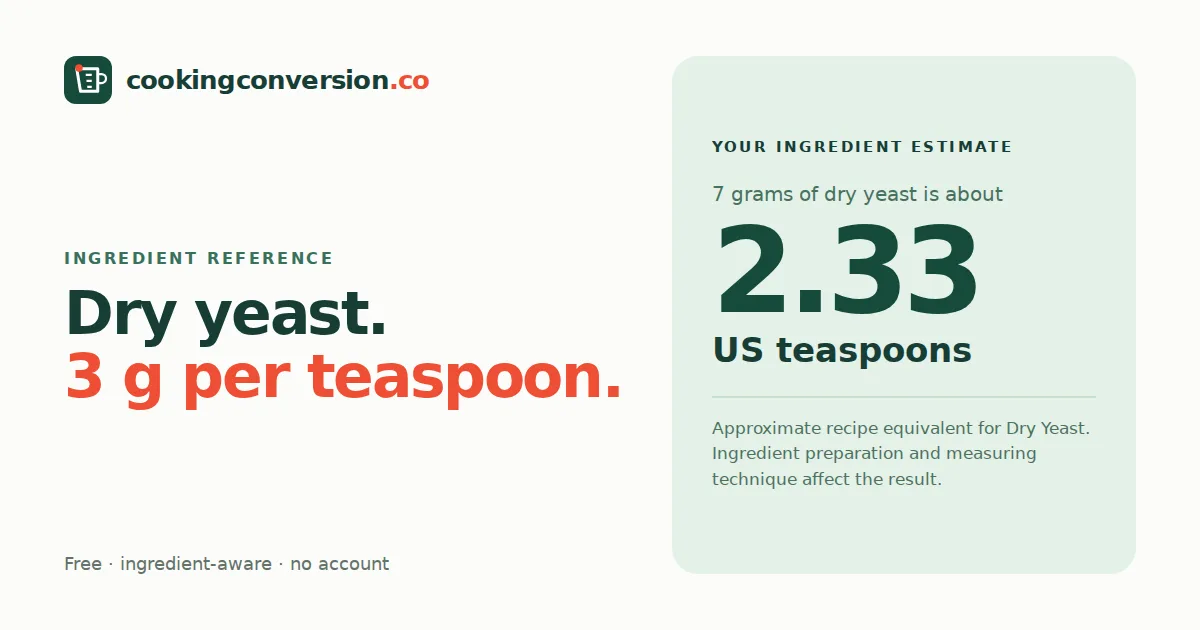
Why 7 grams is "2¼ teaspoons" and not exactly 2⅓
King Arthur Baking weighs instant yeast at 9 grams per tablespoon, which is 3 grams per teaspoon. By that reference 7 grams is 2.33 teaspoons. The same chart also lists 2¼ teaspoons as 7 grams, the contents of one standard packet. Both are rounded kitchen figures: 2¼ teaspoons at 3 g each is 6.75 g, which the chart rounds to 7.
For a single loaf the difference between 2¼ and 2⅓ teaspoons is a pinch and will not change the result you can see. If a recipe gives yeast in grams, a scale that reads to 0.1 g or 1 g is more reliable than any spoon, because granules settle and a heaped spoon can hold noticeably more than a level one.
Packets, jars and blocks
A packet (sachet) of dry yeast in the US holds ¼ ounce, which is 7 grams and, according to Fleischmann's, about 2¼ teaspoons. Recipes written as "1 packet" or "1 envelope" mean this amount. Three packets are sold as a ¾-ounce strip.
Jarred yeast is the same product without the packaging, so measure it with a level measuring spoon or, better, weigh it. Compressed fresh yeast (cake yeast) is a different product: Fleischmann's gives one 0.6-ounce cake as the equivalent of one packet of dry yeast. That is roughly 17 g of fresh yeast in place of 7 g of dry, so never swap them gram for gram.
Instant, active dry and rapid-rise yeast
Instant, rapid-rise and bread-machine yeast are fine granules that can go straight into the flour. Active dry yeast has larger granules and should be dissolved in the recipe's warm liquid first. By volume and by packet the two are used in the same amounts: a packet of either is ¼ ounce and about 2¼ teaspoons.
Fleischmann's says instant yeast can replace active dry yeast directly, added to the dry ingredients. Going the other way works too, but active dry yeast must be completely dissolved first. Timings in the recipe may change, so watch the dough rather than the clock.
Where the numbers come from
The weight per spoon comes from the King Arthur Baking ingredient weight chart, which lists instant yeast at 9 g per tablespoon, 6 g per 2 teaspoons and 7 g per 2¼ teaspoons. Packet size and substitutions are from Fleischmann's Yeast. US spoons are 4.93 ml (teaspoon) and 14.79 ml (tablespoon); metric spoons are 5 ml and 15 ml, so a metric teaspoon holds about 3.04 g. Checked September 28, 2026.