Unit to unit

Millilitres to teaspoons converter

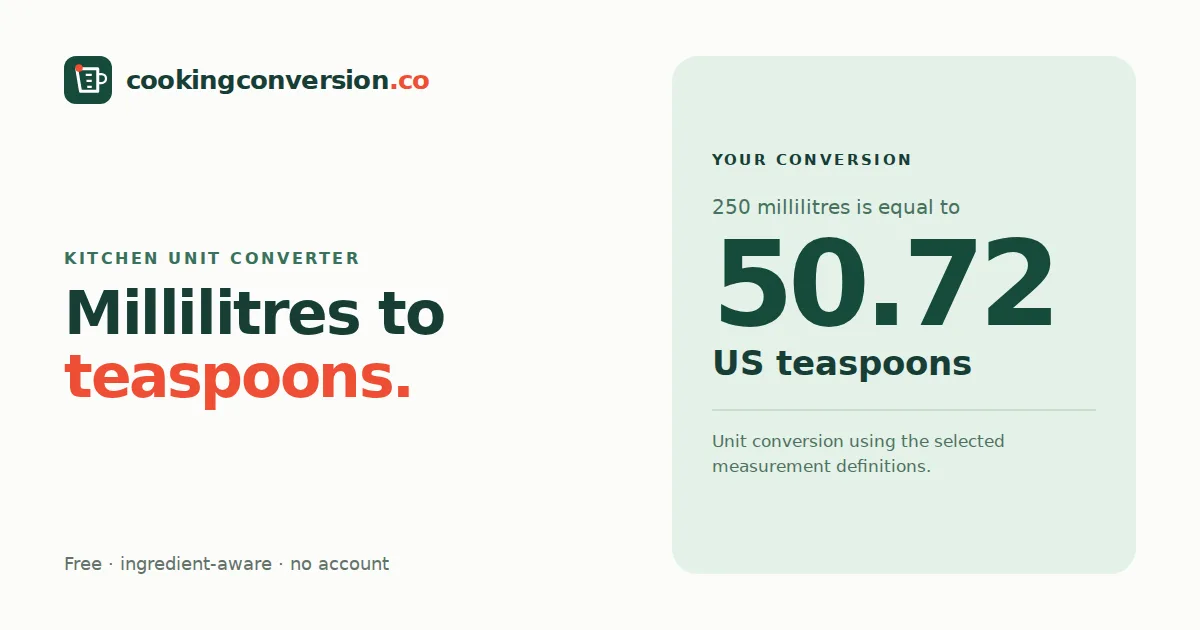
250 millilitres is equal to 50.72 US teaspoons. Both units measure volume, so the conversion is exact for the selected measurement system.

Your kitchen converter

Decimals and fractions welcome: 0.5, ½ or 1 1/2.

Your conversion

250 millilitres is equal to

50.72

US teaspoons


Unit conversion using the selected measurement definitions.

More precision: 50.721 US teaspoons.

Volume depends on the ingredient and the measuring method. Results crossing weight and volume are recipe estimates.

Millilitres to teaspoons table

US customary definitions. Values rounded to four decimals.

Millilitres to teaspoons, US customary definitions
MillilitresTeaspoons
5 ml1.0144
15 ml3.0433
50 ml10.1442
100 ml20.2884
200 ml40.5768
250 ml50.721
500 ml101.4421
1,000 ml202.8841

The millilitres amounts most often searched for this conversion. Every value comes from the same engine as the calculator.

Most searched millilitres to teaspoons amounts (exact, US customary)
MillilitresTeaspoonsAs people search it
1 ml0.2029 US teaspoons1 ml to 1/4 tsp
2 ml0.4058 US teaspoons2 ml to tsp
5 ml1.0144 US teaspoons5 ml to tsp
7.5 ml1.5216 US teaspoons7.5 ml to tsp
15 ml3.0433 US teaspoons15 ml to tsp
20 ml4.0577 US teaspoons20 ml to tsp
30 ml6.0865 US teaspoonshow many teaspoons is 30ml
Millilitres to teaspoons converter: 250 millilitres is equal to 50.72 US teaspoons
Formula. teaspoons = millilitres × 0.2029. Example: 250 ml → 50.721 US teaspoons.

How to convert millilitres to teaspoons

Both units measure volume, so no ingredient is involved. The converter turns your input into a shared base unit (millilitres) and divides by the target unit's factor. Millilitres are the base unit; one teaspoon is 4.9289 millilitres.

The full factors are kept until the final display is rounded. Use the "more precision" line on the result card when you need more decimals, and remember that a rounded kitchen fraction is a convenience rather than an exact equivalent.

Millilitres, litres and the cup you own

A litre is exactly 1,000 ml. A US customary cup is 236.59 ml, a metric cup is 250 ml and the "legal" cup printed on US nutrition labels is 240 ml, so 250 ml is 1.0567 US cups but exactly 1 metric cup. Switch the system above to match the cup your recipe was written for.

For volumes below 60 ml, spoons are usually easier than a cup: 15 ml is a metric tablespoon (14.79 ml in US customary measures) and 5 ml is a teaspoon. The popular-conversions table above covers the millilitre amounts people look up most.

What are millilitres and teaspoons?

A millilitre is one thousandth of a litre, the same volume as one cubic centimetre. Metric measuring jugs and spoons are marked in millilitres.

A US teaspoon is 4.93 ml, a third of a tablespoon. Metric and Australian teaspoons are 5 ml.

Specific to this conversion

Millilitres to teaspoons: questions people ask

How many teaspoons are in one millilitre?

Exactly 0.2029 US teaspoons in US customary measures. In metric or Australian mode the cup or spoon size changes, so the number changes with it.

What is 5 millilitres in teaspoons?

5 millilitres is exactly 1.0144 US teaspoons. It is the most searched amount for this page; the calculator handles any other value.

Are metric and Australian spoons different sizes?

A metric tablespoon is 15 ml and a teaspoon 5 ml; the Australian tablespoon is 20 ml. The US customary tablespoon is 14.79 ml, close enough to 15 ml for almost every recipe. Switch the system above to see the difference in the result.

How do litres relate to cups, quarts and gallons?

A litre is exactly 1,000 ml, and a US liquid gallon is exactly 3.785411784 litres. A US quart is 946.35 ml, a little less than a litre, which is why a "quart" of stock and a litre carton are not quite interchangeable. One litre is 4.2268 US cups or 4 metric cups.

Sources behind the numbers

Sources checked September 25, 2026. Ingredient values are recipe equivalents, not laboratory densities.

Choose which optional categories cookingconversion.co may use. Strictly necessary storage is always on. You can change your choice at any time from the Cookie settings link in the footer.