Weight meets volume

Pounds to tablespoons converter

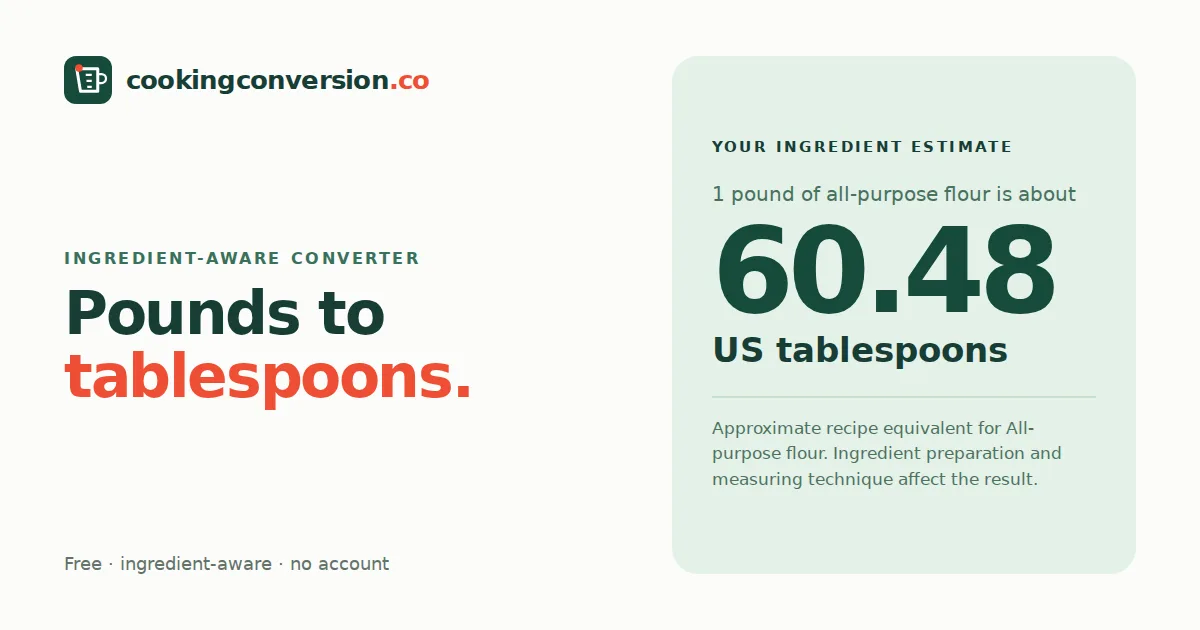
1 pound of all-purpose flour is about 60.48 US tablespoons. Pick the ingredient and cup system your recipe uses; the reference behind every estimate stays in view.

Your kitchen converter

Spoon into the cup and level; do not pack

Decimals and fractions welcome: 0.5, ½ or 1 1/2.

Your ingredient estimate

1 pound of all-purpose flour is about

60.48

US tablespoons


Approximate recipe equivalent for All-purpose flour. Ingredient preparation and measuring technique affect the result.

Reference: 120 g per 236.5882 ml US reference cup. More precision: 60.479 US tablespoons.

Volume depends on the ingredient and the measuring method. Results crossing weight and volume are recipe estimates.

Pounds to tablespoons table

Fixed reference: All-purpose flour · Spoon into the cup and level; do not pack. The calculator above is editable.

Pounds to tablespoons for all-purpose flour at 120 g per US reference cup (approximate)
PoundsTablespoons (approx.)
0.25 lb15.1197
0.5 lb30.2395
1 lb60.479
1.5 lb90.7185
2 lb120.958
5 lb302.3949
Pounds to tablespoons converter: 1 pound of all-purpose flour is about 60.48 US tablespoons
Formula. tablespoons = pounds ÷ grams per tablespoon of the ingredient. Example: 1 lb of all-purpose flour → 60.479 US tablespoons.

How to convert pounds to tablespoons

This calculation crosses from mass to volume, so it needs an ingredient reference. The calculator starts with all-purpose flour at 120 grams per US reference cup (spoon into the cup and level; do not pack). Choose the exact ingredient and form your recipe means before using the answer.

For a weight input, convert to grams, divide by the ingredient's grams per reference cup, then adjust for the selected cup or spoon volume. For a volume input, reverse the process. The answer is a recipe equivalent, not a laboratory density measurement, so brand, moisture, packing and measuring technique can all change the practical result.

Which spoon does the recipe mean?

A US customary tablespoon is 14.79 ml, a metric tablespoon 15 ml and an Australian tablespoon 20 ml; teaspoons are 4.93 ml and 5 ml. For all-purpose flour that makes one US tablespoon about 7.5 g and one Australian tablespoon about 10.1442 g, so the system matters more than the small US-metric difference.

Spoon measures of dry ingredients are the most sensitive to technique: heaped, packed and levelled spoons of the same ingredient can differ by half. Level the spoon with the back of a knife, or weigh the amount when it is critical.

What are pounds and tablespoons?

A pound (avoirdupois) is exactly 453.59237 g, or 16 ounces. US recipes and packaging use it for butter, meat and bulk flour.

A US tablespoon is 14.79 ml, a sixteenth of a US cup and three teaspoons. Metric tablespoons are 15 ml; Australian tablespoons are 20 ml.

Specific to this conversion

Pounds to tablespoons: questions people ask

How many grams is a tablespoon of powder?

It depends on the powder, because each one packs differently. One level US tablespoon: baking powder 12 g, baking soda 18 g, ground cinnamon 7.8 g, cocoa powder 5.25 g, powdered sugar 7.06 g, table salt 18 g. Choose the powder in the calculator above for any other amount.

How many tablespoons are in one pound?

About 60.479 US tablespoons for all-purpose flour using our reference of 120 g per US cup. Another ingredient gives a different answer, because this conversion crosses weight and volume.

What is 2 pounds in tablespoons?

2 pounds of all-purpose flour is about 120.958 US tablespoons. It is the most searched amount for this page; the calculator handles any other value.

Are metric and Australian spoons different sizes?

A metric tablespoon is 15 ml and a teaspoon 5 ml; the Australian tablespoon is 20 ml. The US customary tablespoon is 14.79 ml, close enough to 15 ml for almost every recipe. Switch the system above to see the difference in the result.

Sources behind the numbers

Sources checked September 25, 2026. Ingredient values are recipe equivalents, not laboratory densities.

Choose which optional categories cookingconversion.co may use. Strictly necessary storage is always on. You can change your choice at any time from the Cookie settings link in the footer.